How a Smart Ring Can Help You Understand Your Sleep Patterns
Learn how smart rings track sleep-related data, what sleep stages mean, and how wearable sleep monitoring can help you understand your nightly routines.
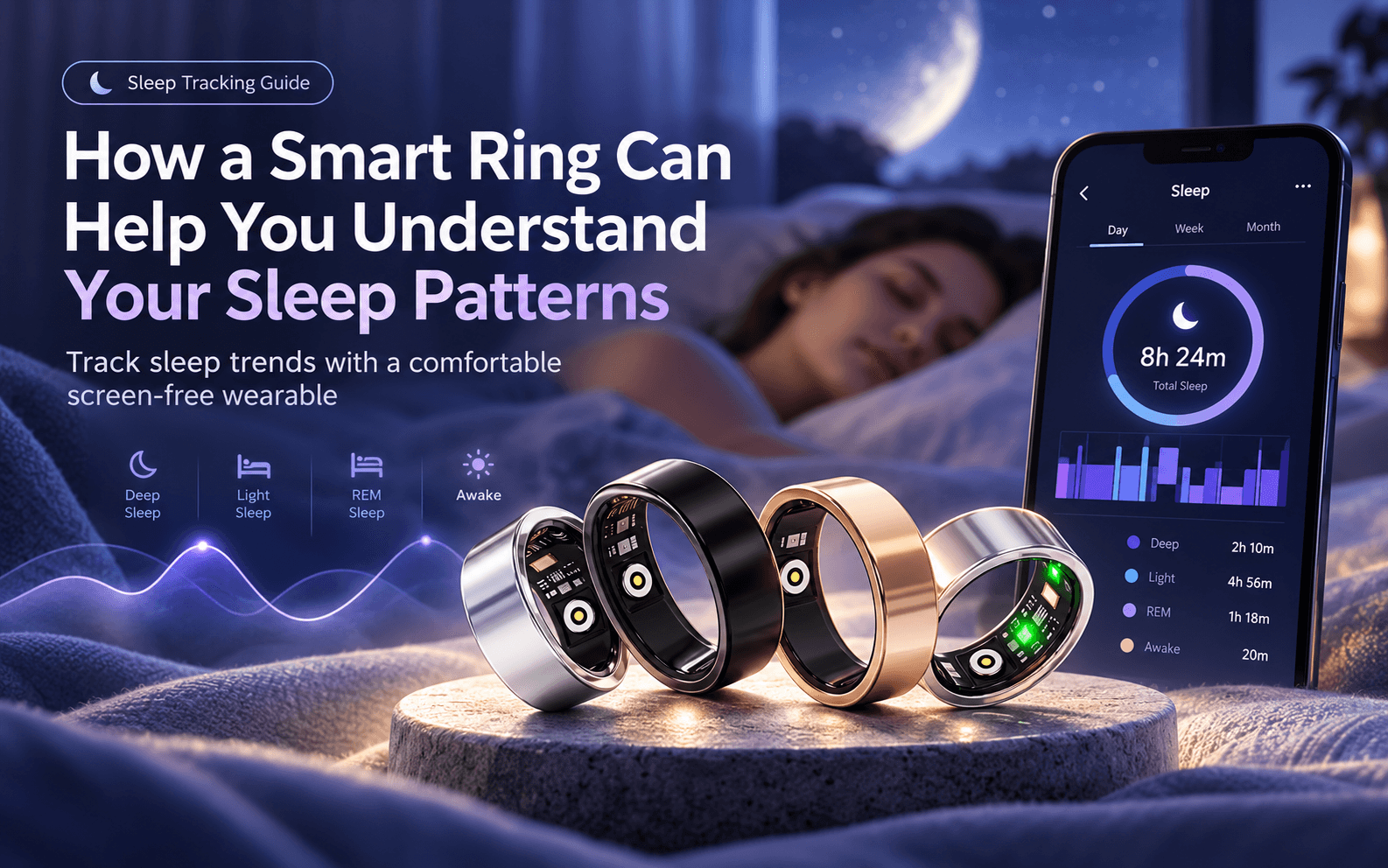
Sleep influences daily energy, concentration, and overall well-being. Yet many people have limited visibility into their own sleep habits. They may know when they go to bed and wake up without understanding how their routines change over time.
Wearable technology offers one way to observe these patterns. A smart ring equipped with supported sleep-tracking features can collect selected physiological signals during the night and present estimated sleep information through a companion application.
Understanding how this technology works—and what its limitations are—can help consumers make better use of their data.
1. How Does Smart Ring Sleep Tracking Work?
A sleep-tracking smart ring typically uses onboard sensors to collect physiological signals while it is being worn.
Depending on the device, these signals may include heart rate, movement, and other supported measurements. Software algorithms process the collected data to estimate aspects of the user's sleep.
The companion application may then display information such as estimated sleep duration, sleep timing, or sleep-stage distribution, depending on the product's capabilities.
Not every smart ring offers the same functions. Some focus on basic sleep duration, while others provide more detailed analysis.
It is therefore important to check the manufacturer's actual specifications rather than assume that all sleep-tracking rings measure the same things.
2. Why Is Sleep Tracking Useful?
The main value of sleep tracking is the ability to observe patterns over time.
A single night's record may not provide much context. Several weeks of data, however, may help users notice recurring differences in bedtime, waking time, or estimated sleep duration.
For example, a user may discover that their sleep schedule becomes less consistent during busy work periods. Another person may notice differences between weekdays and weekends.
These observations can encourage users to review their habits and consider practical changes, such as establishing a more consistent bedtime.
Sleep tracking does not automatically improve sleep. Its value depends on how the information is interpreted and whether it leads to appropriate, sustainable behavior.
3. Understanding Light, Deep, and REM Sleep
Some smart rings provide estimated sleep-stage information.
Sleep is commonly described using several stages:
Sleep-stage estimates from consumer wearables are not equivalent to measurements obtained through clinical sleep studies. The accuracy of these estimates varies by device and algorithm.
Users should focus on general patterns instead of interpreting every nightly change as a meaningful health signal.
4. Why Wearing Comfort Matters at Night
A sleep tracker is only useful when people can wear it consistently.
For some users, a smart ring offers an alternative to wearing a watch or wristband while sleeping. Its compact form may fit naturally into a nighttime routine.
However, comfort depends on correct sizing, ring shape, material, skin sensitivity, and personal preference. A ring that is too tight or too loose can be uncomfortable and may affect sensor contact.
Before choosing a device for overnight use, consumers should review its sizing guidance and recommendations for continuous wear.
5. How to Get More Value from Sleep Data
A practical approach is to treat sleep tracking as a tool for observation rather than a daily performance score.
Consider these habits:
If persistent sleep difficulties or concerning symptoms affect daily life, professional medical advice is more appropriate than relying exclusively on a wearable device.
6. What Should You Check When Buying a Sleep Tracking Ring?
Not all devices are designed for the same purpose. Before buying, evaluate:
These factors determine whether a product is suitable for consistent use.
A smart ring can offer a convenient way to observe sleep-related data without relying on a wrist-mounted screen. By presenting estimated sleep duration, timing, and other supported metrics, it can help users become more aware of their routines.
The most useful approach is to focus on long-term patterns, understand the limitations of wearable estimates, and use the information to support healthy habits rather than treating it as a medical diagnosis.
Explore smart ring features and compare available sleep-tracking capabilities before choosing a device.