How to Choose a Smart Ring Manufacturer for Your Wearable Brand
Learn how to evaluate a smart ring manufacturer, including product specifications, sensor validation, app and SDK support, customization, MOQ, quality control, and compliance.
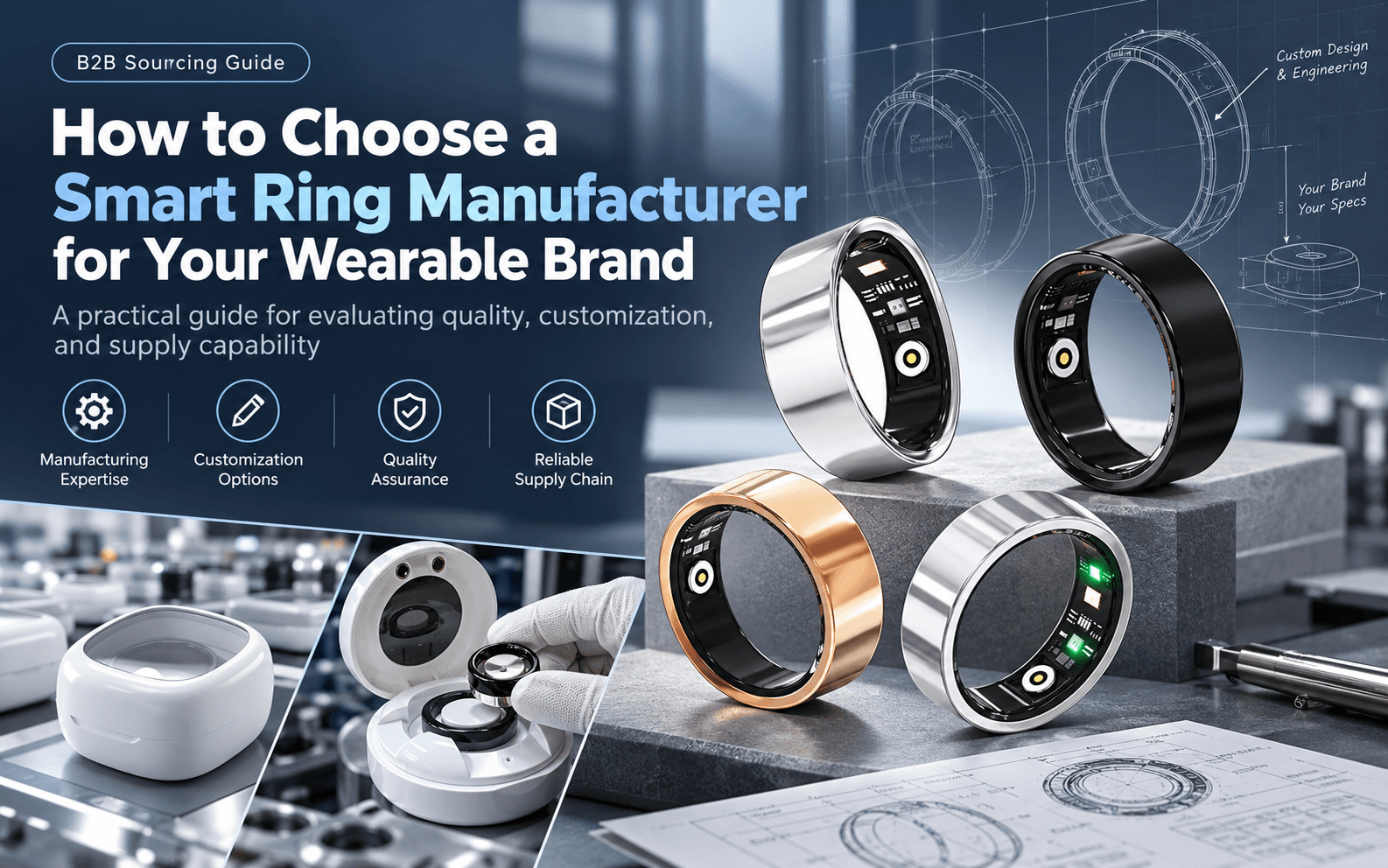
Smart rings are creating new opportunities for consumer electronics brands, wearable technology companies, and distributors looking to expand their product portfolios.
However, selecting a smart ring supplier requires more than comparing product images and unit prices. A successful project depends on the device's actual capabilities, software integration, manufacturing quality, customization scope, and ability to meet the target market's requirements.
For brands planning to launch or expand a wearable product line, a structured supplier evaluation process can reduce uncertainty before a purchase order is placed.
1. Define Your Target Market and Product Positioning
Before contacting manufacturers, establish the intended customer and retail positioning.
Consider whether your target audience prioritizes sleep tracking, everyday wellness, activity monitoring, minimalist design, or premium materials.
You should also define:
These decisions help narrow the supplier shortlist and prevent spending time evaluating products that do not fit the business model.
2. Verify the Product's Actual Specifications
A long feature list does not necessarily indicate a suitable product.
Request a detailed specification sheet covering the hardware, supported functions, operating conditions, and known limitations.
Depending on the intended application, relevant information may include:
Ask the supplier to distinguish standard functions from optional features and functions that require additional engineering.
For health-related metrics, request available performance documentation and clarify the conditions under which the measurements were evaluated.
3. Evaluate the Companion App and SDK
The application is a critical part of a smart ring product.
A wearable may collect data successfully, but the commercial product can still fall short if the application is difficult to use or cannot support the brand's requirements.
During supplier evaluation, determine whether the project will use an existing application, a branded application, or an integration with your own software.
Questions worth asking include:
Do not assume that an SDK provides every raw sensor signal or allows unrestricted access to every function. Request the SDK documentation and confirm the supported interfaces before committing to a development plan.
4. Understand Customization Options
OEM, ODM, and private-label projects can involve different levels of customization.
A private-label project may focus on branding an existing product. More extensive OEM or ODM work may involve product specifications, mechanical changes, software integration, or other engineering requirements, depending on the supplier's capabilities.
Clarify the scope of work before requesting a final quotation.
Typical questions include:
In our product development discussions, we distinguish existing capabilities from changes that require technical evaluation. This helps establish a realistic scope before commercial terms are finalized.
5. Review Manufacturing Quality and Testing
Product quality should be evaluated using evidence rather than general assurances.
Ask about the supplier's quality management process, inspection procedures, incoming component checks, production testing, and final inspection.
For smart rings, relevant evaluation areas may include:
If the product will be sold in regulated or compliance-sensitive markets, identify the applicable requirements early.
Request relevant test reports and certification documents for the exact product configuration being considered. A generic company certificate does not automatically demonstrate that a particular smart ring meets all applicable product requirements.
6. Calculate the Full Cost of the Project
The lowest unit quotation does not always produce the lowest overall project cost.
A realistic cost assessment should include more than the product price.
Potential cost elements include:
Clarify the quotation basis, such as EXW or another agreed Incoterm, and confirm what is included in the price.
The appropriate MOQ also depends on the customization scope, production economics, and supplier policy. Confirm it for the specific project rather than assuming that every product has the same minimum.
7. Test Samples Before Bulk Production
Sample evaluation is an important checkpoint before a larger order.
Where possible, assess the actual product under realistic usage conditions.
A structured sample review should cover:
For projects involving a custom app or SDK integration, software testing should be planned alongside hardware evaluation.
Document the acceptance criteria before approving production so that both parties understand what constitutes a satisfactory result.
8. Assess Communication and Long-Term Support
A smart ring project may involve hardware, firmware, mobile applications, testing, and ongoing product maintenance.
Clear communication is therefore a commercial advantage.
Evaluate whether the supplier can provide timely technical answers, explain limitations, identify dependencies, and establish realistic project milestones.
It is also worth clarifying how defects, firmware issues, software updates, and future product changes will be handled.
A supplier that communicates constraints early can be more valuable than one that promises every requested feature without sufficient technical evidence.
9. Build a Supplier Evaluation Scorecard
A simple scorecard can help teams compare several suppliers consistently.
Score each supplier against the same criteria, using documented evidence wherever possible. The weights can be adjusted to reflect the project's priorities.
A supplier should not receive a high technical score simply because a feature appears in marketing material. Important claims should be confirmed through documentation or sample testing.
Choose with Clear Requirements and Verified Evidence
Choosing a smart ring manufacturer is a multi-dimensional decision involving hardware, software, quality, customization, and commercial execution.
The strongest supplier relationship begins with clear requirements, verified product capabilities, transparent pricing, and a structured sample evaluation process.
We recommend defining the target market and essential functions first, then evaluating suppliers against consistent technical and commercial criteria. This approach helps brands reduce project uncertainty and build a more reliable foundation for product launch.