How to Evaluate Smartwatch Battery Life Before Bulk Purchasing
Discover how to assess smartwatch battery life for bulk orders by comparing battery capacity, actual runtime, GPS usage, display settings, and testing conditions.
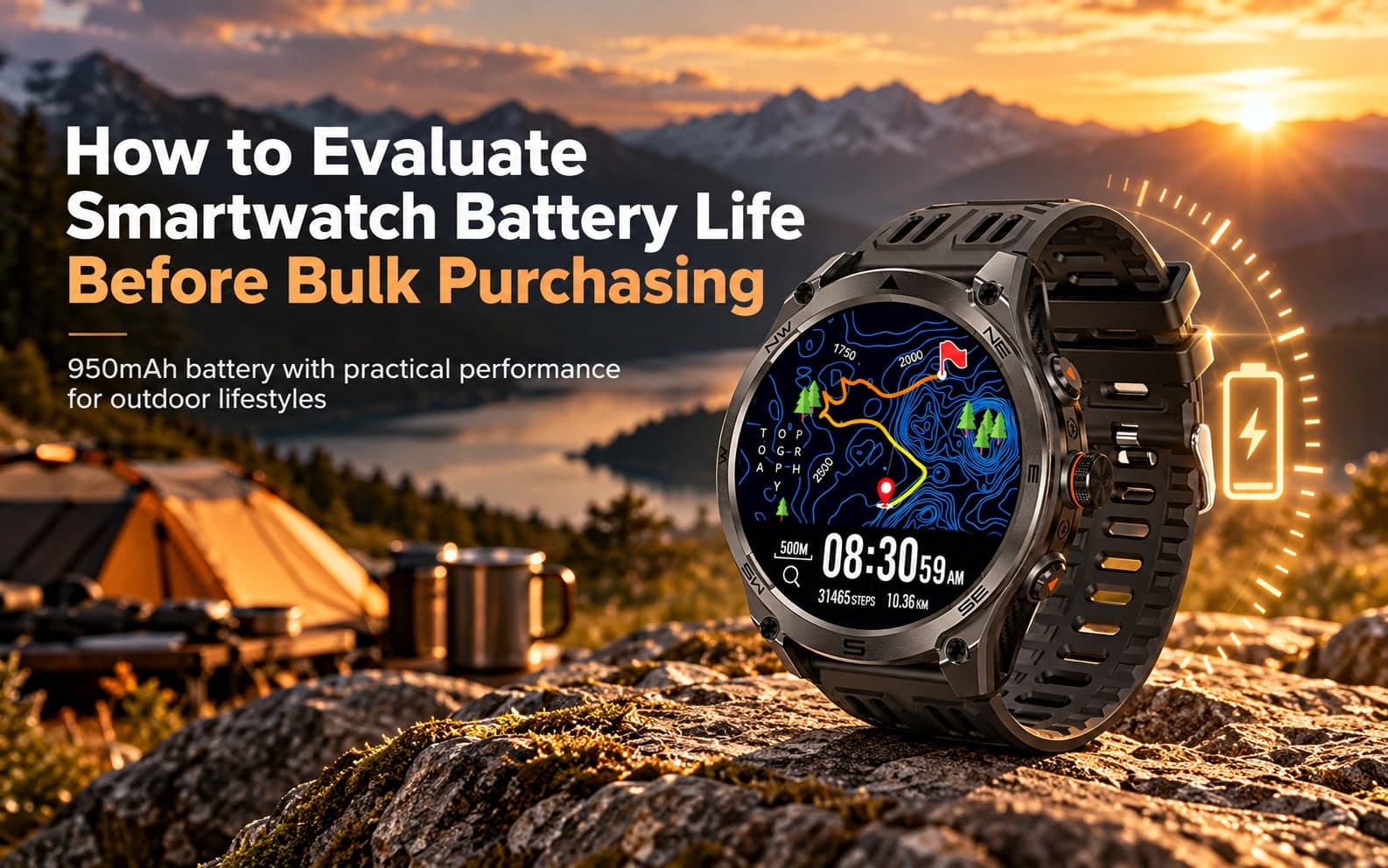
Battery life is one of the most practical considerations for consumers choosing a smartwatch.
This is especially true for outdoor users who may spend extended periods hiking, camping, traveling, or participating in other activities away from convenient charging facilities.
For brands and distributors, battery performance can also influence customer expectations and after-sales communication.
However, comparing smartwatch battery life requires more than looking at the battery capacity printed on a specification sheet.
1. Why Battery Capacity Does Not Tell the Whole Story
Smartwatch battery capacity is commonly expressed in milliampere-hours (mAh).
A larger capacity indicates that a battery can store more electrical charge under specified conditions, but it does not automatically guarantee longer operating time.
Actual smartwatch runtime depends on several factors, including the display, processor efficiency, sensor operation, software settings, and wireless connectivity.
Two products with similar battery capacities may perform differently during daily use. This is why wholesale buyers should focus on both battery capacity and measured operating conditions.
2. Understand the Difference Between Standby Time and Normal Usage
Manufacturers commonly provide several battery-related specifications.
These figures should not be treated as interchangeable. For accurate comparison, buyers need to understand the testing conditions behind each claim.
3. MA70 Outdoor Smartwatch Battery Specifications
Our MA70 outdoor smartwatch features a 950mAh battery.
According to its specifications, the device provides approximately 5 to 7 days of normal usage depending on operating conditions.
The smartwatch also includes a 1.75-inch AMOLED display, GPS, health monitoring, and other outdoor-oriented functions. These features make it suitable for evaluation by brands interested in outdoor lifestyle products.
However, different usage patterns can affect battery performance. For example, continuous GPS activity may consume additional power compared with normal daily operation.
Therefore, the normal usage figure should not be presented as continuous GPS runtime.
4. What Factors Affect Smartwatch Battery Performance
Understanding these factors helps buyers establish realistic battery expectations.
5. How Wholesale Buyers Can Test Battery Performance
Before placing a bulk order, brands should establish a repeatable testing procedure.
First, record the hardware and firmware versions. Next, fully charge the device according to the manufacturer's instructions. Then define a consistent daily usage scenario.
The test should record screen settings, Bluetooth connection status, health monitoring frequency, and activity tracking duration.
If GPS performance is important for the target market, a separate GPS battery test should be conducted.
Results should be documented so that different samples or models can be compared under similar conditions.
6. Why Accurate Battery Claims Matter for Your Brand
Consumers judge battery performance through everyday experience.
If the device needs to be charged more frequently than expected, the difference may lead to disappointment and additional customer service inquiries.
For private-label brands, transparent battery specifications support a more credible product presentation.
Instead of promoting only the largest available number, brands should explain how battery performance may vary under different usage conditions. This helps consumers choose products that better match their needs.
Final Thoughts
Battery capacity is an important specification, but it should never be used as the only indicator of smartwatch battery performance.
Wholesale buyers should evaluate normal usage, GPS operation, display behavior, and the testing conditions behind advertised figures.
The MA70 combines a 950mAh battery with a range of fitness and outdoor functions, offering a potential option for brands looking for an outdoor lifestyle smartwatch.
Searching for smartwatches with practical battery performance for your customers?