A Practical Guide for Building Your Own Wearable Brand
Discover how to launch a private-label smart ring, from product selection and branding to app integration, MOQ planning, sample testing, and mass production.
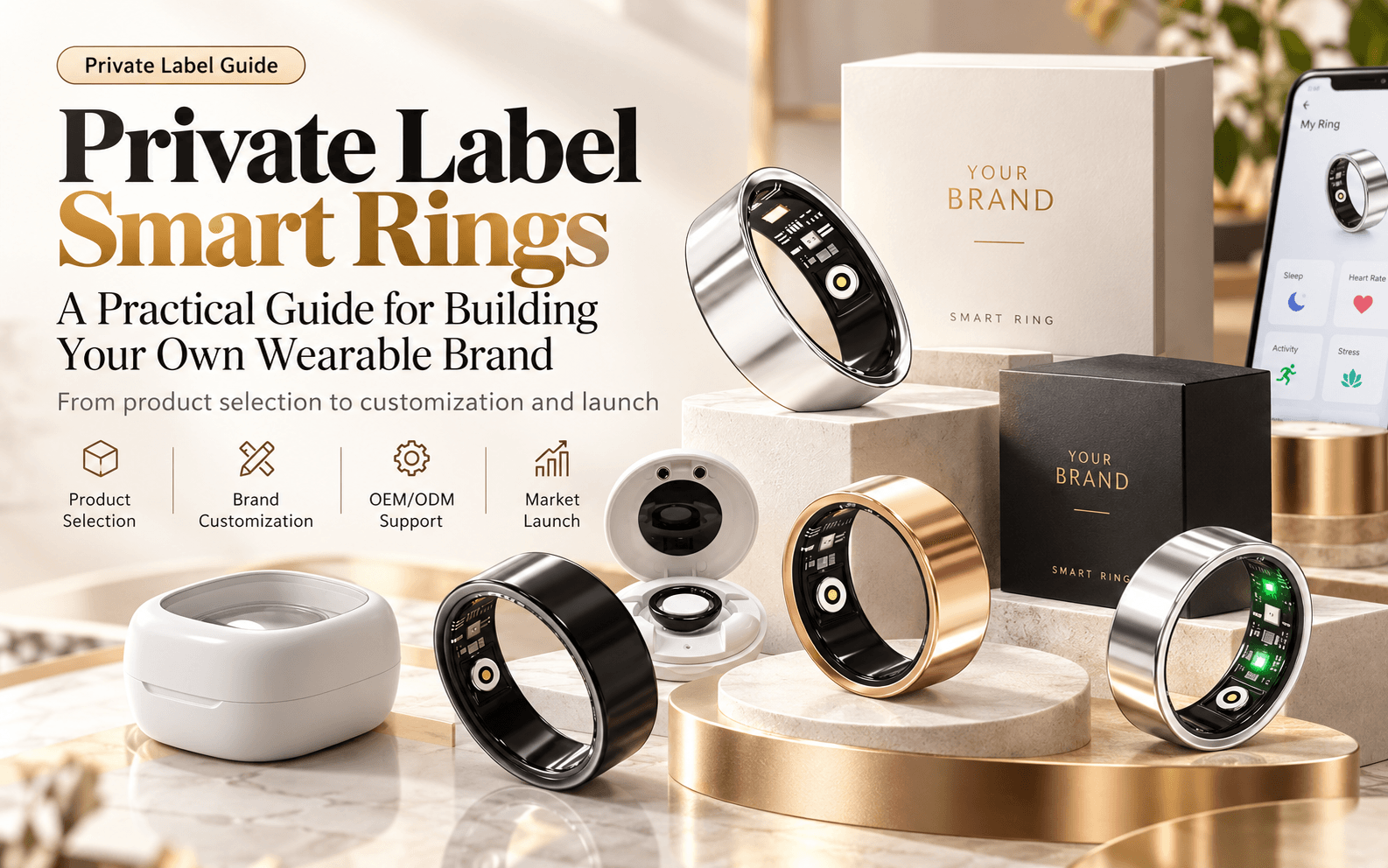
For consumer electronics brands and distributors, smart rings offer an opportunity to expand into wearable technology without necessarily developing every component from scratch.
A private-label approach can allow a business to bring an existing product to market under its own brand, subject to the supplier's available customization options and commercial terms.
However, a successful launch requires more than placing a logo on a device. Product selection, software compatibility, quality assurance, positioning, and supply planning all influence the final result.
This guide explains the main steps involved in building a private-label smart ring product line.
1. Define the Customer and Market Opportunity
Start by identifying the customers the product is intended to serve.
Possible audiences include:
Each audience may prioritize different features, design choices, and price points.
A product designed around premium appearance may require a different commercial strategy from one focused on entry-level activity tracking.
Research competing products in the intended sales markets and identify gaps in design, positioning, feature selection, or distribution.
The goal is not to include every available function. It is to build a clear product proposition that matches a specific audience.
2. Choose Between Standard Products and Deeper Customization
Private-label, OEM, and ODM arrangements can cover different levels of involvement.
These terms are not used identically by every supplier, so the actual scope of work should always be documented.
For a first launch, an existing product with limited customization may reduce development complexity. More extensive changes may be appropriate when differentiation is essential and the expected sales volume can support the additional cost.
3. Select the Right Product Configuration
Before requesting samples, create a product requirement document.
It should identify the essential functions, target price, design preferences, intended use, and any market-specific requirements.
For a smart ring, the review may cover:
Separate essential requirements from optional features.
This makes it easier to identify suitable products and avoid paying for functions that do not support the target customer's needs.
4. Plan Branding and Packaging
Branding helps a private-label product establish a recognizable market identity.
Depending on the supplier's capabilities, customization may include approved logo placement, packaging design, product presentation, and selected color or finish options.
Before confirming the project, clarify:
A consistent visual identity can improve product presentation, but the packaging should accurately describe the device's supported functions.
Avoid unsupported claims about health measurements, accuracy, or medical use.
5. Decide How the App Will Work
The companion application can be one of the most important decisions in a smart ring project.
There are several possible approaches, depending on the existing product and supplier capabilities.
Before selecting an approach, confirm the available documentation, licensing terms, supported data fields, firmware update process, and long-term maintenance responsibilities.
An SDK should not be assumed to provide unrestricted access to every sensor signal or function. The actual interfaces and permitted use need to be verified.
Software requirements should be confirmed early because they may influence product selection, development costs, and launch timing.
6. Confirm MOQ, Pricing, and Development Costs
MOQ is an important consideration for brands entering a new product category.
The minimum order quantity may depend on whether the project uses a standard product, customized packaging, modified appearance, or more extensive engineering.
Ask the supplier to separate the commercial elements clearly:
For our private-label projects, the standard MOQ is generally 1,000 pieces per model for supported basic customization, such as approved logo and packaging options. Other project requirements may need separate assessment.
Confirm the MOQ for the exact product and configuration before finalizing your business plan.
7. Evaluate Samples and Validate the Product
A sample should be treated as a technical and commercial evaluation step rather than merely a visual preview.
Test the device against the agreed requirements.
Check its appearance, fit, pairing, supported monitoring functions, charging behavior, app experience, and synchronization.
If your project includes customized software, evaluate the relevant workflows and data interfaces as well.
Where measurement performance matters, define the testing conditions and acceptance criteria in advance. Request supporting documentation for any critical performance claims.
Record issues clearly and confirm which changes will be implemented before mass production.
8. Prepare for Compliance and Market Entry
Requirements can vary according to the intended market, product configuration, radio functions, battery design, and the claims made in product marketing.
Before launching, identify the applicable regulatory requirements and confirm which documents or testing activities are needed.
Request relevant reports for the exact product configuration. Do not assume that documents for a different model or component automatically establish compliance for your product.
Also review labeling, packaging information, user instructions, warranty arrangements, privacy requirements, and any applicable consumer protection obligations.
Health-related marketing requires particular care. General wellness tracking should not be presented as medical diagnosis or treatment unless the product is appropriately supported and authorized for that intended use.
9. Plan Production and Supply Continuity
Once the sample and specifications are approved, document the final production requirements.
The approval package should include the agreed product configuration, artwork, packaging, software version where relevant, inspection criteria, and commercial terms.
Before placing a larger order, establish:
For products involving mobile software, discuss how compatibility changes, firmware updates, and ongoing technical support will be managed.
These details help create a more predictable supply process as the business grows.
10. Build a Sustainable Product Strategy
A private-label launch should be evaluated beyond the initial purchase order.
Consider whether the product has a clear audience, whether its supported features match customer expectations, and whether the app experience can sustain long-term use.
It is also useful to gather feedback from early users and channel partners before expanding the range.
Future development can then focus on verified customer needs, such as additional supported features, new designs, improved usability, or a more integrated software experience.
The best expansion strategy is one that builds on actual market feedback rather than adding features simply because competitors advertise them.
Build a Reliable Foundation for Launch
Launching a private-label smart ring involves coordinated decisions across product selection, branding, software, quality, compliance, and supply planning.
Starting with a clearly defined audience and a verified product configuration can reduce development complexity. A structured sample process and transparent commercial agreement can then help establish a reliable foundation for launch.
We support discussions around smart ring product selection, available customization options, and project requirements. The appropriate solution depends on your target market, desired functions, software plans, and expected order quantity.