Smart Ring Health Tracking: Understanding the Value of Everyday Health Data
Discover how smart rings collect and display everyday health data, which monitoring features to compare, and how to interpret wearable measurements responsibly.
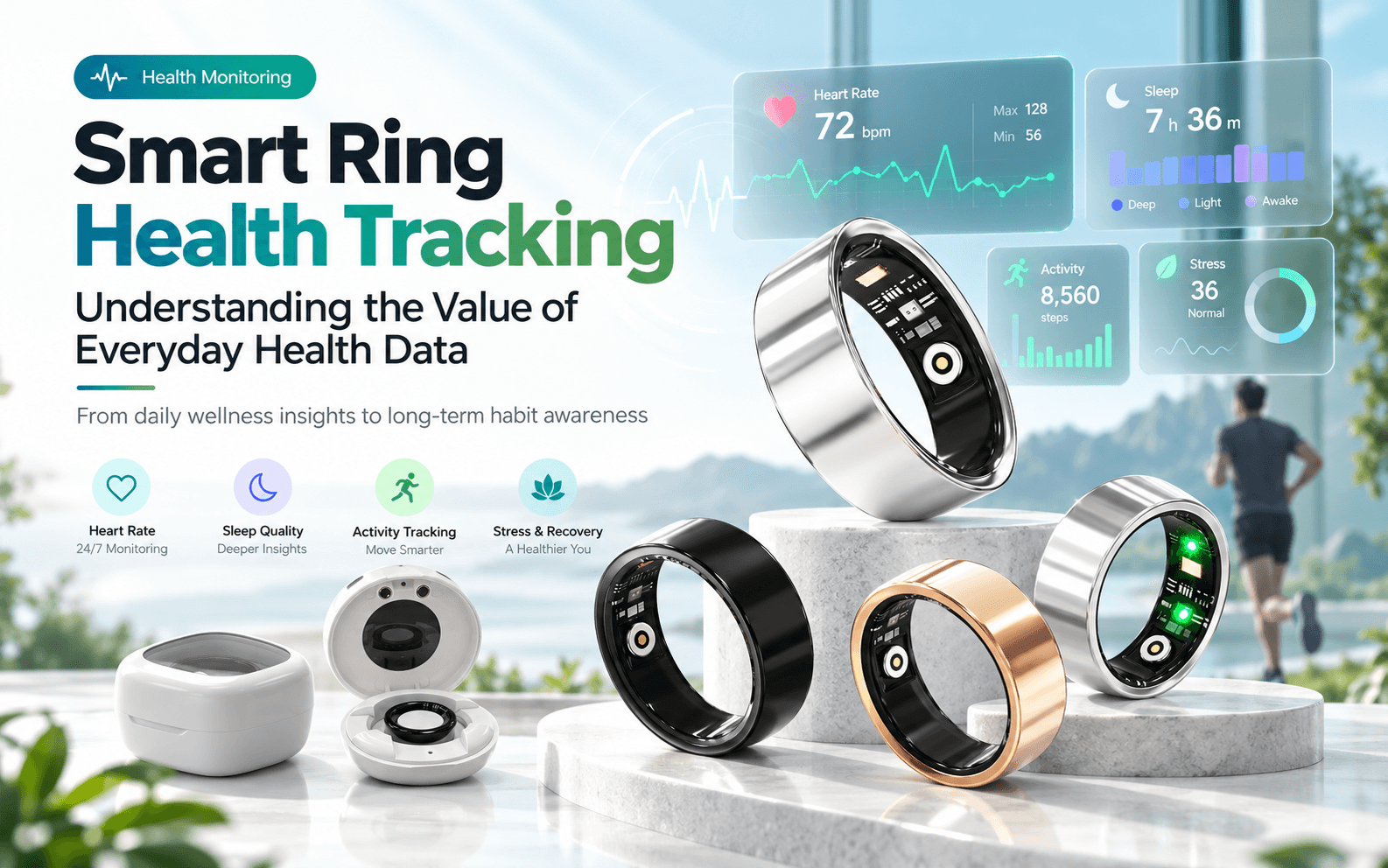
Wearable health technology has changed how people interact with personal wellness information. Instead of relying only on occasional measurements, consumers can use connected devices to observe selected physiological signals and activity patterns throughout their daily routines.
Smart rings are one example of this development. Their compact form allows supported sensors to collect data while the device is worn, with results typically displayed through a companion smartphone application.
However, the value of a smart ring depends on more than the number of metrics shown on a screen. Understanding what the device measures, how the data is processed, and what the results can—and cannot—tell users is essential.
1. What Can a Smart Ring Monitor?
Available monitoring features vary by product.
Depending on the hardware and software, a smart ring may support selected functions such as:
These functions should not be assumed to be available on every model.
For example, heart rate monitoring and blood oxygen estimation rely on specific sensing capabilities and appropriate software support. Other metrics may require additional algorithms, calibration, or particular usage conditions.
When evaluating a device, buyers should consult its detailed specifications and verify how each metric is measured and presented.
2. How Do Smart Ring Sensors Collect Data?
Many wearable health devices use optical sensing technology to measure changes in light absorption associated with blood flow near the skin.
Depending on the sensor configuration, these signals can support measurements such as heart rate. Other sensors may capture movement or additional physiological signals.
The collected data is processed by onboard software or companion applications to produce understandable results.
Measurement quality depends on multiple factors, including sensor design, device fit, skin contact, movement, environmental conditions, and the algorithms used.
This is why two products that advertise similar functions may deliver different user experiences and measurement performance.
3. Why Trends Can Be More Useful Than Individual Readings
A single measurement provides limited context.
For example, heart rate can change with physical activity, emotional stress, sleep, temperature, and other everyday factors. A reading taken after exercise should not automatically be compared with one recorded during rest as though the conditions were identical.
Historical data can provide a broader perspective.
When users review trends across days or weeks, they may better understand how their routines relate to changes in the measurements recorded by their device.
However, consumer wearable data is not a substitute for a clinical assessment. Unexpected readings or persistent symptoms should be discussed with an appropriate healthcare professional.
4. The Role of the Companion App
The application is a major part of the overall smart ring experience.
A well-designed app should help users understand their records without requiring technical knowledge. Depending on the product, useful elements may include:
For buyers evaluating different products, app usability deserves as much attention as the physical device.
A capable sensor is less useful if users cannot easily access, understand, or manage the information it produces.
5. Continuous Monitoring Does Not Mean Continuous Accuracy
Some wearable devices are designed to collect measurements at regular intervals or during selected periods. However, the exact monitoring frequency and operating conditions differ between products.
Continuous or frequent data collection does not guarantee that every reading is accurate.
Movement, loose fit, poor sensor contact, and other conditions can influence measurement quality. Some features may also be unavailable during particular activities or when the device is not worn correctly.
Consumers should therefore review the product's stated limitations and follow its wearing instructions.
6. What Should Buyers Look for in a Health Tracking Ring?
When comparing products, consider the following questions:
These questions help distinguish a well-defined product proposition from a feature list that lacks supporting information.
7. Health Technology Should Support Informed Decisions
The strongest consumer health technology experiences are not necessarily those with the most complicated dashboards. They are the ones that help people understand relevant information and use it appropriately.
For smart ring developers and wearable brands, this means paying attention to sensor reliability, algorithm validation, app design, user education, and responsible product claims.
It also means clearly distinguishing general wellness tracking from functions that have been clinically validated or authorized for medical purposes.
Smart rings can provide convenient access to selected health and activity data in a compact wearable format. Their practical value depends on the supported measurements, sensor performance, app experience, and the user's ability to interpret the results responsibly.
Before selecting a device, verify its actual features, review available performance evidence, and understand the limitations of consumer wearable measurements.
Review the available smart ring specifications to identify the health tracking features that match your needs.