Why Long Battery Life Is Becoming a Key Selling Point in Wearables
Learn why battery life is becoming one of the most important product considerations for fitness trackers and wearable health devices.
Wearable technology continues to become more sophisticated.
Health monitoring, sports tracking, sleep analysis and smart notifications are now common across many devices.
However, one fundamental product issue remains important:
How often does the user need to charge the device?
Charging Frequency Affects the Wearable Experience
Unlike smartphones, wearable devices are designed to remain on the body for long periods.
This is especially important for functions such as sleep monitoring, resting heart-rate tracking and long-term activity analysis.
Every time the device is removed for charging, data collection is interrupted.
For this reason, battery life is not simply a technical specification. It directly affects how the product is used.
Why Screen-Free Products Can Help
Displays consume power.
Products that remove or simplify the display can allocate more battery capacity toward sensors, Bluetooth connectivity and background monitoring.
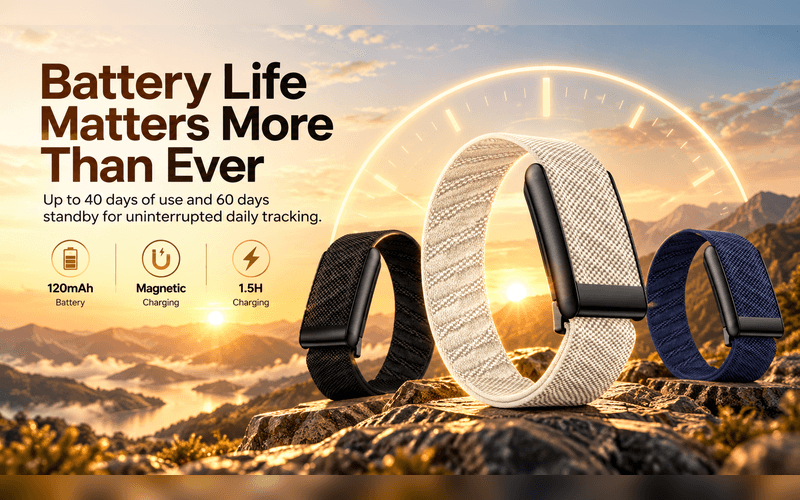
The A50, for example, uses a screen-free design and a 120mAh lithium-polymer battery.
Its specified operating time reaches up to approximately 40 days, with up to 60 days standby, depending on actual settings and use.
A Simple Benefit Consumers Understand
Some wearable specifications can be difficult for consumers to compare.
Processor models, sensor architecture and software algorithms may matter technically, but they are not always easy to communicate at retail.
Battery life is different.
Consumers immediately understand the benefit of charging less frequently.
For brands and distributors, this makes long battery life both a functional advantage and a strong marketing message.