Why Screen-Free Wearables Are Gaining Attention in Health Tracking
Discover why screen-free wearables are gaining interest in health tracking, from longer battery life and lower distraction to continuous wellness monitoring and sleep tracking.
For years, wearable technology has followed a familiar direction: larger screens, more notifications, more apps, and more interaction.
That approach works well for smartwatches designed to extend smartphone functions to the wrist. But health tracking has a different set of priorities.
For many users, the value of a health wearable is not how often they look at it. The real value may come from how consistently they can wear it.
This is one reason screen-free wearables are attracting increasing attention in the health and wellness market.
Rather than competing with traditional smartwatches on display size or entertainment functions, a screen-free health band focuses more on continuous wear, wellness tracking, battery efficiency, and reduced digital distraction.
For brands, distributors, and consumers, this creates a different way to think about wearable technology.
From Interactive Wearables to Continuous Health Tracking
Traditional smartwatches are highly interactive devices.
Users receive messages, answer calls, check notifications, change watch faces, and open applications throughout the day.
A health-focused wearable does not always need the same interaction model.
In many wellness scenarios, the most important role of the device is to quietly collect data over time.
Heart rate, blood oxygen, HRV, sleep patterns, activity levels, and other wellness-related information can become more useful when they are viewed as trends rather than isolated measurements.
This changes the product design question.
Instead of asking:
“How much information can we display on the wrist?”
A health wearable can ask:
“How easily can the user continue wearing this device throughout the day and night?”
That is where a health wearable without a screen can offer a different user experience.
1. Less Screen Interaction, Less Digital Distraction
Modern consumers already interact with multiple screens every day.
Phones, laptops, tablets, televisions, and smartwatches all compete for attention.
A screen-free wearable takes a different approach.
The device can remain on the wrist without continuously asking the user to look at another display.
This may be especially relevant for users who want wearable health tracking but do not necessarily want more notifications or screen interaction.
For work, sleep, exercise, and daily routines, a screen-free design can make the wearable feel more passive.
The wearable collects information in the background, while the smartphone becomes the main place for reviewing data.
This creates a simple product philosophy:
Less screen interaction. More continuous tracking.
2. Continuous Wear Can Be More Important Than Feature Count
The wearable market often competes by adding more functions.
However, the number of features is only one part of the user experience.
A device can support dozens of functions, but if users frequently remove it because of charging, discomfort, or distraction, long-term tracking may become less consistent.
For health-focused wearables, continuous wear can be particularly important.
Sleep tracking, daily activity recording, heart rate trends, and other wellness data all depend on the device being worn regularly.
This is why factors such as comfort, power consumption, battery life, and device simplicity deserve as much attention as the feature list itself.
A screen-free design may support this goal by reducing one of the most power-intensive and interaction-heavy components of a traditional smartwatch: the display.
3. Longer Battery Life Supports Continuous Wellness Tracking
Battery life is one of the most practical issues in wearable technology.
Frequent charging can interrupt daily use.
If a user removes a device at night to recharge it, sleep tracking may be interrupted. If the user forgets to put it back on, the data gap becomes even larger.
For this reason, long battery life health bands can be particularly attractive for continuous wellness monitoring.
The AE54 Screen-Free ECG Smart Health Band, for example, is specified with a 180mAh battery, approximately 7–15 days of usage time, and 30+ days of standby time.
This makes battery performance part of the overall health-tracking experience rather than simply a hardware specification.
For the user, fewer charging interruptions can make daily tracking more convenient.
For brands and distributors, battery life also provides a simple and understandable product benefit that can be communicated clearly to consumers.
4. Sleep Tracking Is a Natural Use Case for Screen-Free Wearables
Sleep monitoring is one of the strongest use cases for a screen-free wearable.
During sleep, the user does not need a display.
What matters more is whether the wearable is comfortable enough to remain on the wrist and whether it can continue collecting data throughout the night.
A screen-free health band can therefore focus more on the wearing experience rather than on visual interaction.
The AE54 includes 24-hour scientific sleep monitoring among its listed wellness functions.
Combined with extended battery life and a no-screen design, this creates a natural positioning around continuous daily and nighttime tracking.
For consumers who already keep their smartphone nearby, reviewing sleep data in the companion APP may be more practical than trying to analyze detailed information on a small wrist display.
5. The Smartphone Becomes the Main Data Interface
Removing the screen from the wearable does not mean removing access to information.
It simply changes where the information is viewed.
With a screen-free health band, the wearable can focus on sensing and data collection, while the smartphone provides the larger interface for reviewing trends.
The AE54 works with the G Band APP, allowing health and activity information to be accessed through a mobile device.
This separation can make sense from a user-experience perspective.
The band handles continuous wearing.
The smartphone handles deeper viewing and data interaction.
Instead of duplicating another screen on the wrist, the product relies on the device people already use for detailed information.
6. Health Tracking and Fitness Tracking Are Converging
Screen-free wearables are not limited to passive wellness monitoring.
Modern health bands can also support fitness and daily activity tracking.
The AE54 specification includes step counting, calories, distance tracking, and 120+ sports modes, along with IP68 waterproof protection and BLE 5.3 connectivity.
This means a screen-free wearable can still support a wide range of active lifestyle scenarios.
The difference is that the device does not need to behave like a traditional smartwatch.
It can focus on recording activity while leaving detailed data review to the APP.
This can appeal to consumers who want health and fitness tracking without constant screen interaction.
7. Multi-Dimensional Wellness Tracking Creates Broader Use Cases
One reason health wearables continue to develop rapidly is the growing demand for more comprehensive wellness data.
The AE54 specification includes multiple functions related to health and wellness tracking, including ECG heart health analysis, heart rate monitoring, blood oxygen monitoring, HRV monitoring, women’s health tracking, body composition-related functions, stress monitoring, and sleep tracking.
This gives the product a broader wellness positioning than a basic step counter or entry-level fitness band.
For B2B buyers, that can make a screen-free wearable relevant across several market segments, including fitness, lifestyle, sleep, wellness, and health-oriented consumer electronics.
However, the way these features are communicated matters.
Wellness functions should not automatically be presented as medical diagnosis functions unless the relevant medical certifications, clinical validation, and regulatory evidence are available.
For international marketing, responsible wording such as wellness tracking, health trend monitoring, and daily health management is more appropriate when medical-grade evidence has not been provided.
8. Screen-Free Health Bands Offer a Different Market Position
The wearable market is crowded.
Many smartwatches now offer similar combinations of large displays, calling functions, notifications, sports modes, and health features.
For brands and distributors, this creates a challenge:
How do you differentiate another wearable product?
A screen-free fitness tracker or screen-free smart health band provides a different answer.
Rather than competing directly with smartwatches, the product can be positioned around a different set of priorities:
This makes the product category easier to explain and potentially easier to differentiate in a crowded wearable market.
9. Screen-Free Does Not Mean Feature-Free
One common misconception is that removing the screen makes a wearable less capable.
In reality, screen-free design is more about changing the role of the device.
The wearable becomes less of an interactive mini-computer and more of a continuous sensing tool.
The smartphone takes over detailed visualization, while the wearable focuses on staying connected to the user throughout everyday life.
For certain customers, that may be exactly what they want.
Not another screen.
Not another stream of notifications.
Just a wearable that quietly supports daily wellness tracking.
The AE54 as a Screen-Free Health Wearable
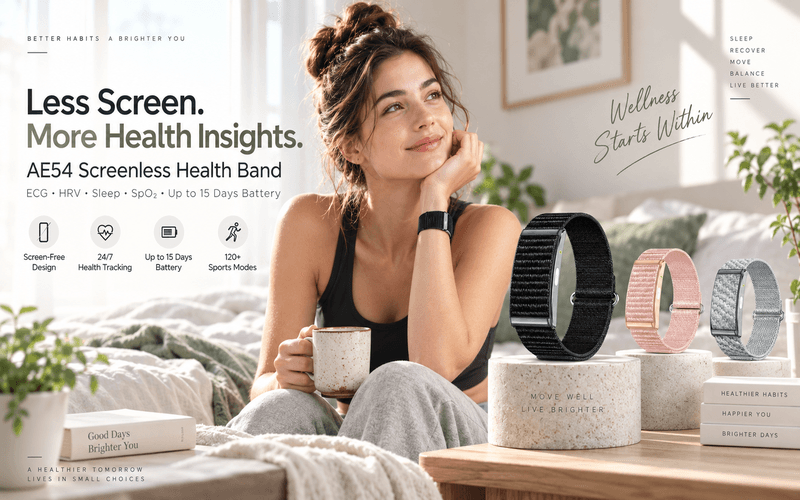
The AE54 Screen-Free ECG Smart Health Band is designed around this concept.
Its specification includes a no-screen design, G Band APP control, ECG-related wellness functions, heart rate monitoring, blood oxygen monitoring, HRV, sleep monitoring, 120+ sports modes, IP68 waterproof protection, BLE 5.3, and approximately 7–15 days of battery life.
Rather than positioning AE54 as another conventional smartwatch, it can be presented as a:
Screen-Free Health Band for Continuous Wellness Tracking
This positioning helps communicate both what the product is and why the screen-free format matters.
The Future of Wearables May Be Less About Screens
Smartwatches will continue to play an important role in wearable technology.
But they may not be the only direction.
As the wearable market becomes more mature, different products can serve different user needs.
Some wearables will become more interactive.
Others may become more passive, lighter, lower-power, and easier to wear continuously.
For health and wellness applications, this second direction may become increasingly important.
The future of wearable technology may not simply be about adding more features.
It may be about creating devices that fit more naturally into everyday life.
And for some users, that could mean wearing technology that does more while demanding less attention.