Why Simpler Fitness Trackers May Keep Users Engaged Longer
Discover why simpler fitness trackers with long battery life, fewer distractions, and continuous health tracking may help users stay engaged and wear their devices more consistently.
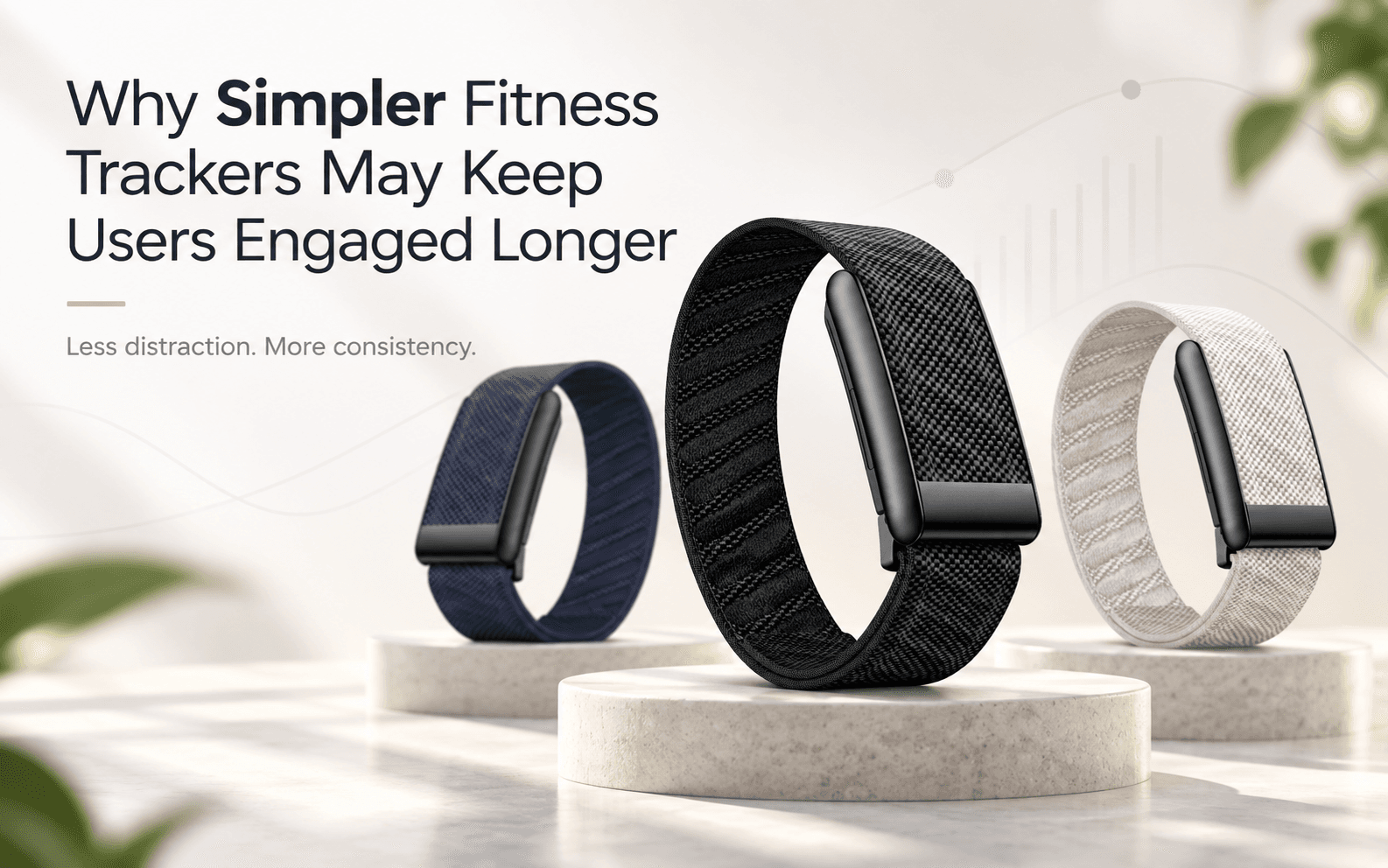
Fitness trackers have become more advanced than ever.
Today’s wearable devices can display messages, answer calls, track workouts, monitor heart rate, measure blood oxygen, analyze sleep, show weather updates, control music, and even run apps directly from the wrist.
Yet one important question remains:
Are people actually wearing them consistently?
For health-focused wearables, this question matters more than it may seem.
A device can offer dozens of features, but if users frequently remove it, forget to charge it, become overwhelmed by notifications, or stop checking their data, its long-term value quickly decreases.
This is why a new idea is gaining attention across the wearable industry:
Sometimes, a simpler fitness tracker may create a better long-term user experience.
The Real Challenge Is Not Buying a Fitness Tracker — It Is Continuing to Wear It
Buying a wearable is easy.
Staying engaged with it for months is much harder.
Many consumers begin with strong motivation. During the first few days, they check every step, heart rate measurement, sleep score, and workout result.
But over time, several common frustrations may appear.
Eventually, the wearable may spend more time on a desk than on the user’s wrist.
For wearable brands, this creates an important product development question:
Should the goal be to add more features, or to remove the reasons users stop wearing the device?
1. Frequent Charging Interrupts the Wearable Experience
Battery life remains one of the most practical issues in wearable technology.
Consumers already charge multiple devices every day, including smartphones, wireless earbuds, tablets, laptops, and smartwatches.
Adding another device that requires frequent charging can quickly create friction.
For a health tracker, charging creates another problem:
Missing data.
If a user removes the tracker overnight to charge it, the device may miss sleep data. If it stays on the charger during a workout, activity data is lost. If the user simply forgets to put it back on, tracking may stop for several days.
This matters because many wearable insights become more useful when data is collected consistently over time.
Heart rate trends, sleep patterns, stress indicators, activity habits, and HRV data all benefit from continuity.
That makes battery life more than a specification. It directly affects how consistently the wearable can do its job.
2. More Screens Can Mean More Distractions
Consumers already live in a highly connected environment.
Phones display notifications. Computers deliver emails. Tablets stream content. Smartwatches can add yet another layer of alerts, reminders, messages, and vibrations.
For some users, this constant flow of information can create digital fatigue.
A health-focused wearable does not necessarily need to compete for attention.
This is where screen-free fitness trackers offer a different experience.
Instead of asking users to interact with another display throughout the day, a screen-free wearable can collect information quietly in the background. Users can then check their health and activity data through the companion app when they choose.
This changes the relationship between the person and the device. The wearable becomes less of an extension of the smartphone and more of a dedicated health-tracking tool.
3. More Features Do Not Always Create More Value
The wearable industry has spent years competing through feature expansion.
But consumers do not necessarily use every function available to them.
For users primarily interested in health and fitness, a smaller group of features may matter much more:
These functions provide information that users can follow over time. For this type of customer, simplicity can make the product easier to understand.
Instead of asking: “How many things can this device do?” A better question may be: “Does this device consistently track the things I actually care about?”
4. Continuous Wear Can Be More Important Than Constant Interaction
Wearable technology works differently from many other consumer electronics products. The user does not always need to actively interact with it.
In fact, some of the most valuable wearable data is collected while the user is doing nothing at all.
This means a health tracker can provide value even when the user is not looking at it.
For this reason, one of the most important qualities of a wearable may simply be: The user is willing to keep it on.
A simpler device with fewer interruptions, longer battery life, and passive tracking can support this type of continuous-use experience.
5. Sleep Tracking Makes Long Battery Life Even More Important
Sleep is one of the clearest examples of why wearable consistency matters.
Many consumers want to understand:
But the wearable needs to remain on the wrist during the night to collect that information.
If the device regularly needs charging at bedtime, the user faces a trade-off: Charge the device or track sleep.
A wearable designed for longer battery life reduces this conflict. Instead of planning daily routines around charging, users can keep the tracker on for longer periods and charge it less frequently.
This creates a more natural relationship with the product.
6. Simpler Wearables May Reduce User Fatigue
Feature fatigue is not unique to wearables. Many consumer technology products become more complicated over time.
New functions are added. Menus grow. Settings multiply. Notifications increase.
Eventually, the product may require more attention than the user wants to give it. For a fitness tracker, this can be counterproductive.
Health tracking should ideally fit into daily life with minimal effort. A simpler wearable experience can help reduce the number of decisions the user needs to make.
There is less to configure. Less to check. Less to manage.
The device becomes something the user wears rather than something the user constantly operates.
7. Screen-Free Fitness Trackers Take a Different Approach
Screenless wearables reflect a broader shift in product philosophy. The goal is not necessarily to replace a smartwatch. Instead, they serve a different type of user.
Some consumers want a full smartwatch experience with calls, messages, apps, maps, and a large display. Others may want a device focused primarily on health, sleep, exercise, and recovery.
For these users, a screen-free fitness tracker can offer several practical advantages:
This does not mean screenless wearables are better for every user. It means they address a different set of priorities.
A50: Designed Around Continuous Health Tracking
The A50 Screen-Free Health & Fitness Tracker follows this simpler approach to wearable design. Instead of adding another display to the wrist, the device focuses on continuous health and activity tracking.
A50 supports key wellness indicators including:
The data can be reviewed through the connected QWatch Pro app, allowing the wearable itself to remain simple and screen-free.
Up to 40 Days of Battery Life
One of A50’s most important design advantages is battery life.
With a 120mAh battery, A50 offers:
Actual battery performance can vary depending on usage, tracking frequency, Bluetooth connection, and enabled functions.
However, the design objective is clear: Reduce charging interruptions so users can spend more time wearing the device.
For health tracking, this can help support more consistent day-and-night data collection.
The Best Wearable May Be the One You Forget You Are Wearing
Wearable technology often focuses on interaction.
Tap the screen. Read a notification. Open an app. Start a function.
But health tracking can work differently. An effective health wearable may not need the user’s attention every few minutes.
Instead, the experience can be:
This philosophy can make wearable technology feel less demanding. And that may be one reason simpler fitness trackers can support longer-term engagement.
What This Means for Wearable Brands
For wearable brands, importers, distributors, and retailers, the growth of simpler health trackers creates another product direction beyond traditional smartwatches.
A screen-free wearable does not necessarily need to compete directly with full-featured watches. It can complement them.
A brand may offer:
This allows brands to serve different user needs within the same wearable portfolio.
Simplicity May Become a Competitive Advantage
For years, wearable innovation has often been defined by adding more.
More sensors. More apps. More functions. More screens.
But future product development may also involve deciding what users do not need.
If a simpler device helps users charge less, interact less, feel less distracted, and wear the product more consistently, simplicity itself can become a meaningful product advantage.
The next generation of health wearables may not be defined only by how much technology they place on the wrist. It may also be defined by how naturally that technology disappears into everyday life.
The long-term success of a fitness tracker depends on more than specifications.